Book Appointment Now

What Happens When an EV Battery Reaches End of Life
EV car batteries rarely fail suddenly; they lose usable capacity gradually. Range shrinks, charging slows, and peak power drops as cells age. The vehicle will signal issues and a technician can assess whether the pack stays in service, is repurposed for stationary use, or goes to recycling. Repurposing extends value and reduces environmental impact. Proper end-of-life handling saves money and cuts waste.
What Counts as EV Battery End of Life?
A battery doesn’t become “dead” the moment its range starts shrinking, and that’s an essential thing to know.
You’re usually looking at end of life when the pack drops to about 80% of its original capacity or power, though some makers set warranty thresholds a bit lower.
That doesn’t mean your EV gives up right away. Instead, heat, age, and thermal degradation slowly nudge performance down.
Your car might still feel fine if it meets your daily needs, which is why this stage can feel less like a failure and more like a shift.
In practice, the exact line depends on the vehicle, climate, and warranty rules. So you’re not alone in case it seems fuzzy; the industry uses a range, not one magic number.
What Are the Signs an EV Battery Is Wearing Out?
You’ll usually notice an EV battery wearing out initially through reduced driving range, since the car can’t hold as much energy as it used to.
You might also see slower charging speeds, because the battery doesn’t accept power as quickly once it ages.
Should warning lights pop up on your dashboard, your car is telling you it’s time to pay attention.
Reduced Driving Range
As soon as an EV battery starts to wear out, the initial sign you usually notice is reduced driving range, and that change often occurs little by little. You could drive the same routes, yet need to plug in sooner. That can stir up range anxiety, especially whenever you’re juggling work, errands, or a weekend trip with friends.
Because the car can’t go as far on one charge, your trip planning gets tighter. You start checking chargers, weather, and traffic before you leave. You may also notice that the battery gauge drops faster than it used to.
That doesn’t mean your EV is giving up on you. It just means the pack has aged, and you’re adjusting with it.
Slower Charging Speed
As soon as your EV battery starts to wear out, charging can take longer than it used to, and that can be one of the initial clues that something’s changing. You might plug in at your usual spot and notice the battery climbs more slowly, especially near the top of the charge. That happens because the pack can’t accept energy as quickly once cells age.
If this keeps happening, battery diagnostics can help you see whether the slowdown comes from battery wear, temperature, or the charger itself. In the meantime, you can keep things smooth with smart charging etiquette, like avoiding rushed top-offs and giving the pack time to settle before another session. Small shifts like these can feel annoying, but they’re also familiar signs that many drivers observe together.
Dashboard Warning Lights
Upon a battery starting to wear out, the dashboard often speaks up before the car feels seriously different, and that warning can catch you off guard. You’ll usually see driver alerts or warning indicators for battery health, charging faults, or reduced power. Whenever these lights stay on, your EV is asking for attention, not drama.
| Warning indicator | What you might notice |
|---|---|
| Battery light | Lower range |
| Charge fault | Slower charging |
| Reduced power | Gentle acceleration |
| Service alert | Checkup needed |
These signs often show up together, so don’t brush them off. Should your car keep flashing the same message, you’re not alone, and that message helps your service team track wear before it grows into a bigger problem.
What Happens Before an EV Battery Is Retired?
Before an EV battery is retired, it usually starts to show a slow, steady drop in performance, and that change can feel frustrating should you’re counting on the car for daily driving.
You might notice shorter range, slower charging, or less punch whenever you press the pedal.
At this stage, battery diagnostics help you see how much capacity and power the pack has left, so you can judge what’s normal and what’s not.
That review also shows warranty impacts, since a low state of health can affect coverage and next steps.
Even so, your car could still feel dependable for a while. The battery doesn’t quit all at once; it just asks for more care, more planning, and a little more patience from you.
Can an EV Battery Get a Second Life?
Yes, your EV battery can often get a second life as repurposed energy storage, especially whenever it still has enough capacity for lighter work.
You could see it supporting grid backup applications, homes, or buildings where steady power matters more than driving range.
And once it can’t serve safely anymore, recycling steps in to recover precious materials like lithium, nickel, and cobalt.
Repurposed Energy Storage
A retired EV battery doesn’t have to end its story at the scrap pile. You can give it a second job as repurposed energy storage, and that choice keeps good materials working for your world.
After screening, a healthy pack can support community microgrids, store solar power for evening use, or steady agricultural irrigation systems during busy hours. You get more value from the same battery, and your local group gains a practical backup for daily needs.
Because these systems run at gentler levels than a car, the battery can often serve for years more. That extra life also lowers waste and eases pressure on new mining. Whenever you choose reuse, you help build a circle of support that feels smart, steady, and shared.
Grid Backup Applications
Whenever a retired EV battery still holds enough strength, it can step into grid backup service and quietly help keep the lights on. You can feel better aware it’s still doing useful work for your community. In this role, the pack supports grid resilience during outages, storms, or busy demand spikes.
- It delivers stored power fast whenever the grid gets stressed.
- It helps with peak shaving, so demand stays smoother.
- It supports nearby homes and businesses without much noise.
- It gives you more time to keep routines steady whenever power wobbles.
Because these systems sit still and work at gentler levels, they often last longer than in a car. That means you’re not just extending battery life, you’re helping build a safer, stronger energy network together.
Recycling And Recovery
Not every retired EV battery is ready for the scrap heap, and that’s where recycling and recovery come in. You’ll usually see batteries checked, sorted, and sent down the right path after collection.
Should a pack still hold enough life, it can move into second-use storage. In the absence of that, certified recyclers break it down and recover lithium, nickel, cobalt, copper, and aluminum for new packs. That keeps useful materials in your circle and cuts waste.
Safety matters too, because damaged batteries can spark fires or leak harmful chemicals. With policy incentives and trained portable recyclers, you get a safer, cleaner loop that supports your community and future EVs.
Even once the road ends, your battery can still serve a purpose.
How Does EV Battery Reuse Work?
EV battery reuse starts with a careful check, because you can’t just plug an old pack into a new job and hope for the best. You belong in the process when experts assess health, balance, and safety, then sort packs for fresh roles.
- They inspect the pack after removal and storage.
- They review consumer buybacks and warranty transfers to match ownership and service history.
- They select packs with enough life for homes, farms, or backup systems.
- They repackage and monitor the battery so it works in a lower-stress setting.
This reuse path keeps useful energy working longer, and it gives you confidence that the pack still has a place. Provided a battery still performs well enough, it can support your community before it ever heads to its final stage.
What Materials Does EV Battery Recycling Recover?
At the time you recycle an EV battery, you recover prized materials like lithium, nickel, cobalt, copper, and aluminum.
These recovered metals don’t just sit there, either, because they can go back into new batteries and other products.
Recovered Battery Materials
Battery recycling is a material recovery process, and it aims to pull precious metals and other useful parts back out of a worn-out pack. You help keep those resources in play, which feels good because you’re part of a cleaner loop.
In community workshops, people often learn how recyclers sort and separate recovered battery materials, while policy advocacy can push better collection systems.
- Lithium often returns as a feedstock for new cells.
- Nickel and cobalt can reenter battery production.
- Copper and aluminum usually come from wiring and casing parts.
- Plastics, steel, and electrolyte ingredients might also be captured.
When you support this process, you cut waste and strengthen a shared supply chain. That means fewer raw digs, more reuse, and a steadier path for your community.
Valuable Metals Reclaimed
Inside a recycled battery, precious metals don’t just disappear, and that’s the hopeful part. You help keep lithium, nickel, cobalt, copper, and aluminum in play through urban mining, not digging new holes. That matters because every recovered gram can support supply resilience whenever fresh ore gets costly or scarce.
| Metal | Recovered From | Why You Care |
|---|---|---|
| Lithium | Cells | New battery feedstock |
| Nickel | Cathodes | Stronger future packs |
| Copper | Wiring | Reliable power flow |
Whenever recyclers pull these metals back, they also trim waste and reduce pressure on mines. You’re part of a loop that keeps precious materials moving, so yesterday’s drive can help power tomorrow’s ride, without starting from scratch.
How Are EV Batteries Disassembled Safely?
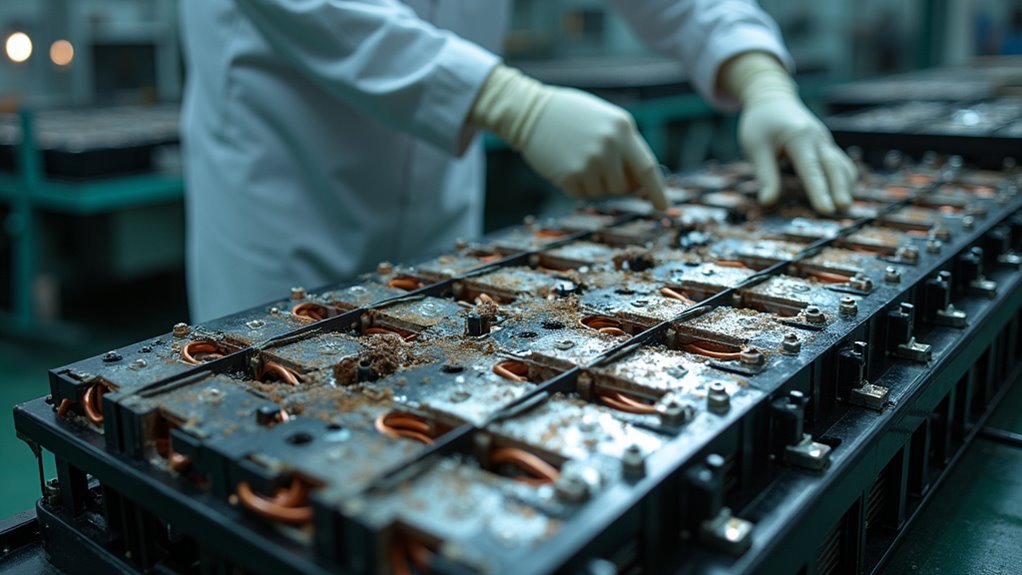
Careful disassembly starts with making the pack safe, because even a retired EV battery can still hold serious electrical energy. You and your team should begin with thermal mitigation and mechanical isolation, so the pack stays cool, still, and separated from other parts.
- Inspect the case for swelling, leaks, or damage.
- Disconnect the high-voltage system and lock it out.
- Remove cover plates with insulated tools.
- Lift modules one at a time and label each piece.
After that, you can sort parts for examination, reuse, or recycling without rushing. Whenever you work calmly, you help protect everyone in the room, and you make the next step feel less intimidating.
That shared care matters, because safe disassembly isn’t just technical work. It’s how you keep the whole crew confident, focused, and ready.
Why Does EV Battery Disposal Need Special Care?
Once you’ve taken an EV battery apart safely, the next challenge is what to do with it, because disposal isn’t as simple as hauling it away. You need to treat it like a battery with a story, not trash with a tail. Even after removal, cells can still hold charge, leak electrolyte, or spark thermal runaway provided they get crushed, wet, or bumped.
That’s why special packaging, clear labels, and transport regulations matter so much. They help protect you, your crew, and the road around you. You also need to keep damaged packs away from heat and metal tools. With careful handling, you lower fire risk, avoid toxic fumes, and give the battery a safer path to reuse, recycling, or another managed step.
Who Handles End-of-Life EV Batteries?
After an EV battery comes out of a vehicle, a few different people could step in, and each one has a clear job. You’ll usually see trusted licensed handlers initially, because they know how to move and store the pack safely. Then a service center or specialist checks whether it can be reused, repaired, or sent onward. Should the maker offers manufacturer takeback, that path can simplify things for you and keep the battery in the right system.
- Licensed handlers secure the battery.
- Inspectors examine its condition.
- The manufacturer reviews takeback options.
- Reuse or recycling teams take over.
That chain helps you stay connected to a safer, cleaner process. It also gives your old battery a next step without leaving you guessing.
What Does EV Battery Recycling Cost and Return?
You might see recycling costs add up fast, but the return can soften the blow. You’ll usually pay for transport, safe storage, testing, and processing, yet those steps protect your team and keep the pack moving through the right channel.
Whenever your battery still holds value, a battery buyback can put cash back in your pocket. Recyclers could also pay for packs with useful metals like nickel, cobalt, copper, and aluminum, though the amount changes with market prices and pack condition.
On top of that, policy incentives can trim fees or lift the payout, especially whenever local programs support certified recycling. So, before you write off the battery, ask for quotes, compare offers, and check whether reuse or recycling brings you the better return.
Why Does EV Battery Recycling Matter for Sustainability?
Once EV batteries reach the end of their initial life, recycling matters because it keeps useful materials in play instead of sending them to waste. You help cut lifecycle emissions whenever you recover lithium, nickel, cobalt, copper, and aluminum instead of mining fresh ore. That saves energy, protects land, and supports cleaner supply chains that feel like a shared win.
- You reduce landfill risks and toxic leaks.
- You lower demand for new raw materials.
- You support safer battery handling and processing.
- You strengthen community engagement around circular energy choices.
Whenever you join this loop, you’re not just disposing of a pack. You’re helping build a system that respects resources, protects neighbors, and gives the next battery a better start.
Frequently Asked Questions
How Long Can a Second-Life EV Battery Usually Last?
You’d usually get another 5 to 10 years from a second life EV battery, depending on its second life lifespan, use, and performance degradation. In lighter stationary storage it can keep supporting your community longer.
What Happens if an EV Battery Is Damaged Before Recycling?
If you damage an EV battery before recycling, you will need battery remediation and hazard containment initially. You will isolate it, inspect for leaks or heat, and send it to certified handlers to prevent fires, fumes, or contamination.
Who Decides Whether a Retired Battery Is Reused or Recycled?
You’ll find government agencies, independent assessors, and manufacturers decide whether you should reuse or recycle a retired battery, evaluating its health and safety, like gatekeepers at a crossroads, so you still belong in the clean energy future.
Can EV Batteries Be Landfilled if They Are No Longer Usable?
No, you generally cannot landfill them because environmental regulations and landfill restrictions treat them as hazardous classification. You will need certified disposal logistics, and proper collection keeps you part of a safer, cleaner battery recovery community.
What Risks Do Stored End-Of-Life EV Batteries Pose?
Stored end of life EV batteries can spark thermal runaway or chemical leakage, risking fires, toxic fumes, and contamination. You’re not alone in handling them. Proper storage and certified care keep your community safer and stronger.