Book Appointment Now

How Parasitic Battery Drain Affects Vehicles
Parasitic battery drain slowly eats a car battery’s charge while the vehicle sits unused. It causes slow engine cranking, dim headlights, and unexpected dead batteries after short periods of inactivity. Some current draw is normal for electronics and security systems, but excessive draw signals electrical faults like shorts or failing modules. Spotting abnormal drain early saves replacement costs and prevents being stranded. This article explains common causes, simple tests to measure draw, and practical steps to fix or reduce parasitic drain.
What Is Parasitic Battery Drain?
Parasitic battery drain is the quiet power loss that keeps nibbling away at your car’s battery even while the ignition is off.
You could suppose everything is asleep, but a few concealed consumers still sip current for memory, alarms, and other needs. That small draw is normal. Trouble starts once it grows too high and your battery can’t keep up.
Newer vehicles often use standby timers, so modules stay awake for a bit before they settle down. Whenever a part stays active too long, it acts like a tiny thief in your system.
You’re not doing anything wrong, and that’s okay. Still, being aware of this helps you feel in control. Your car should rest, recharge, and be ready whenever you are.
Signs Your Car Has Parasitic Drain
In case your car keeps needing jump-starts, that’s often a big clue that something’s draining the battery while it sits.
You might also notice the engine cranks slowly, like it’s waking up on a bad morning, and the cabin lights look dimmer than usual.
Whenever these signs show up together, your battery could be losing power overnight instead of holding it for the next drive.
Repeated Dead Battery
A car that keeps ending up with a dead battery can leave you frustrated fast, especially provided it seems fine the night before and won’t start the next morning. Whenever this happens again and again, you’re not just coping with bad luck. You’re seeing a drain that keeps pulling power while the car sits.
- You jump it, then it dies again.
- You notice capacity loss over time.
- Your starter wear could grow from repeated starts.
- You stop trusting the car on busy days.
That pattern can hit your mood hard, because you want to feel like your ride has your back. Long term, repeated dead batteries can signal a concealed electrical load that keeps draining the battery after shutdown.
Slow Engine Crank
More often than not, a slow engine crank is one of the initial clues that your car’s battery has been getting drained while it sits. You turn the key, and the engine hesitates, groans, or starts after a long pause. That slow starter feel often means the battery’s charge is too low to give the motor a strong push.
Whenever parasitic drain keeps pulling power overnight, the starter works harder than it should, and starter wear can build up fast. You may feel worried, but you’re not stuck. This kind of crank pattern is a real sign that something stayed on or kept drawing power after shutdown. So, should your car cranks lazily more than once, trust that clue and check it soon.
Dim Interior Lights
At the moment the cabin glow turns weak, your car could be sending you an advance warning. You might notice ambient dimming whenever you open a door, and that soft fade can feel off. This isn’t just a mood thing; it often points to parasitic drain pulling power while the car sits still.
- Check whether lights fade faster than usual.
- Notice whether one lamp looks weaker than the rest.
- Watch for flicker after the doors close.
- Listen for sensor sensitivity in courtesy lights that stay active.
Whenever you spot these signs, you’re not alone. Many drivers see this small change before a bigger battery problem. So, trust that weak glow and have the circuit checked soon.
How to Test for Parasitic Drain
Checking for parasitic drain starts with a fully charged battery and a little patience, because the vehicle must sit long enough for every module to go to sleep.
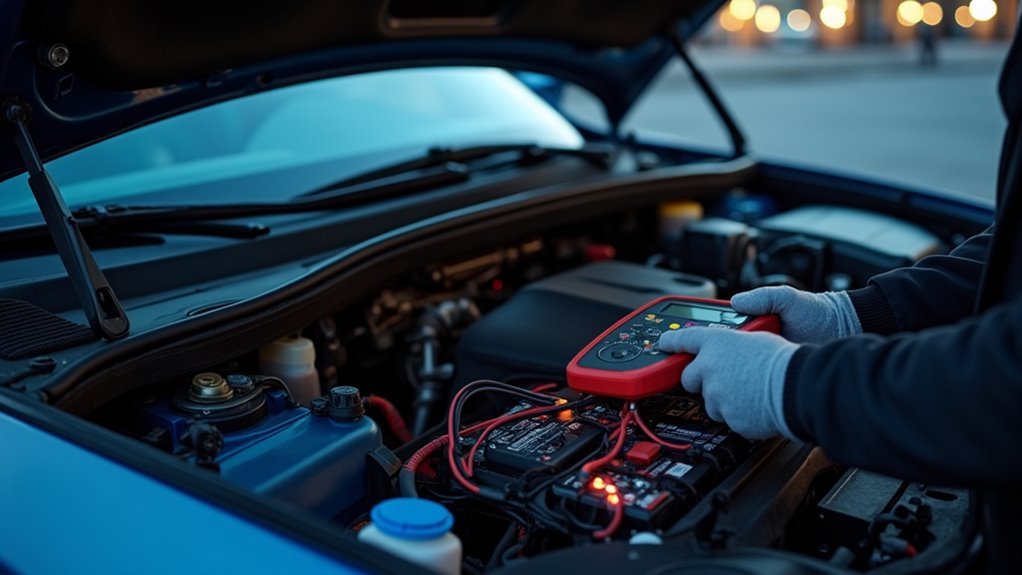
Then you connect a digital multimeter in series with the battery cable and watch the current settle.
For steady battery parasitology, respect module sleep times, since a rushed examination can fool you.
Next, check each fuse one at a time; whenever the reading drops, you’ve found the circuit that needs attention.
In case you’re unsure, ask a friend or trusted tech to help, because you don’t have to do this alone.
Keep the doors shut, lights off, and accessories unplugged.
That simple setup gives you a clear path and a real sense of control.
Normal vs. Abnormal Current Draw
A healthy vehicle always uses a little power after you turn it off, because clocks, alarms, and control modules still need to stay awake. You can regard this as the normal key-off draw that keeps your ride ready for the next trip. After sleep mode starts, a healthy system usually settles into a low, steady pull, often under 50 mA in older vehicles and around 50 to 85 mA in newer ones. Whenever the draw stays higher, something isn’t right.
- Normal draw protects memory.
- Abnormal draw drains trust.
- A module reset can restore calm.
- Too much current can leave you stranded.
If your numbers rise fast, you’re not alone, and your vehicle is asking for help.
Common Causes of Parasitic Drain
A dead battery can feel frustrating, but the cause is often something simple you can spot. Faulty electrical parts, lights left on, and aftermarket accessories can keep pulling power after you turn the vehicle off.
Once you know these common troublemakers, you can narrow the search faster and get your car back to normal sooner.
Faulty Electrical Components
You’re not alone when this happens, and the fix often starts with a few key checks. Wiring corrosion can create tiny paths for current, while a sensor malfunction could keep a module awake when it should rest.
Look for:
- worn connectors
- damaged grounds
- sticky relays
- failing control parts
Each one can quietly drain your battery overnight.
Should you catch the problem sooner, you protect your battery and your peace of mind. You don’t need to guess, either. A steady examination and a careful repair can bring your vehicle back into the group of reliable rides you trust every day.
Lights Left On
Often, the simplest causes are the hardest to spot, and lights left on can drain your battery faster than you’d expect.
You may suppose you only left one dome light glowing, but that small mistake keeps pulling power all night. Should your parking sensors stay active with the cabin light or your emergency flashers keep blinking after you walk away, the battery works overtime.
Over time, that steady draw can leave you with slow cranking and a weak start in the morning. So, take a quick look before you lock up.
Check the headlamps, map lights, trunk light, and any switch that can stay on accidentally. A few extra seconds now can save you from that frustrating no-start feeling later.
Aftermarket Accessories
Aftermarket accessories can sneak up on you and keep pulling power long after you’ve parked. Whenever you add battery accessories or audio upgrades, you want comfort, not a dead start in the morning. Poor wiring, loose relays, and concealed amps can keep your car awake like a friend who never wants to leave.
- Check for parts that stay warm.
- Unplug chargers and adapters.
- Review install notes for switched power.
- Verify each circuit after shutdown.
If a new gadget drains power, you’re not alone, and you’re not stuck. Start with the newest add-on, then watch for the draw to drop. That small step can point you to the trouble fast.
With careful checks, you can keep your ride ready and your crew confident.
Battery Drain From Lights and Relays
A small light that stays on can quietly drain your battery, and a stuck relay can do the same through keeping a circuit alive long after the key is off. You’re not alone when this happens; it’s a common, fixable fault. A cabin bulb, glove box lamp, or headlamp switchfault can leave you with slow starts and a flat battery. Intermittent relaywear might also make the drain come and go, which feels maddening.
| Cause | Clue | Feeling |
|---|---|---|
| Light left on | Warm lens | Frustration |
| Relay stuck | Click after shutoff | Worry |
| Concealed fault | Overnight dead battery | Stress |
If you notice this, check each light and relay together, because one weak part can keep your car awake and your plans on hold.
Aftermarket Accessories That Drain Power
Whenever a light or relay isn’t the culprit, the next thing to check is the gear you added yourself.
Aftermarket accessories can stay awake long after you park, and that quiet draw can wear down your battery. Bluetooth modules, dash cams, phone chargers, and remote starters often keep sipping power provided they’re wired wrong or left in always-on mode.
- Check whether the accessory shuts off with the key.
- Unplug one device at a time and watch for change.
- Look for loose grounds or spliced wires.
- Use a proper fuse tap, not a quick twist and hope.
You’re not alone provided this feels frustrating.
Many drivers join the same club, and the fix is often simple once you trace the add-on that’s acting greedy.
What Parasitic Drain Does to Your Battery
Even a small parasitic drain can quietly wear your battery down, and that means your car could seem fine one day and struggle the next. You lose charge while you’re parked, so the next start asks more from the battery than it can give.
That stress changes battery chemistry, weakens the plates, and cuts into stored energy. Over time, you could notice slow cranking, dim lights, or a battery that won’t bounce back after a short drive.
Should the drain keep happening, it can push the battery into deep discharge and shorten its life. It can also raise warranty implications, because repeated abuse can appear like neglect. Once you understand this, you can spot trouble sooner and protect your ride, your routine, and your peace of mind.
How Long a Battery Lasts With Drain
How long your battery lasts with a drain depends on how much current is leaking, how healthy the battery already is, and how long the vehicle sits unused.
A small drain could only wear it down over days, but a heavier one can leave you with slow cranking, dim lights, or a no-start situation come morning.
The more severe the drain, the faster it cuts into battery life and the sooner you might need a replacement.
Battery Drain Time Factors
Several things decide how long a battery can last while parasitic drain is present, and the biggest one is how fast that concealed current pulls power from the battery as the car sits. You also need to reckon about battery size, age, and temperature effects, because cold weather slows chemistry and heat can accelerate wear.
In seasonal storage, that matters a lot.
- A small draw could take days to matter.
- A stronger draw can drain it overnight.
- An older battery gives you less reserve.
- Extra electronics shorten the safe parking time.
Signs Of Weakening Charge
As parasitic drain starts to sneak up on your battery, the initial signs usually show up in small, frustrating ways. You could notice slow cranking when you turn the key, or headlights that look a little tired at idle.
Those weakening indicators often feel random, but they fit a clear pattern. Next, watch your voltage trends after the car sits overnight. In case the reading drops faster than usual, your battery’s charge is fading between drives.
You might also see the radio reset, the clock blink, or warning lights act strangely. These clues can make you feel stuck, but they also help you spot trouble beforehand.
Whenever your vehicle starts asking for a jump more often, the battery isn’t being dramatic, it’s asking for help.
Drain Severity And Lifespan
Whenever parasitic drain keeps pulling on your battery, its lifespan can shrink a lot faster than you’d expect.
You might still start your car today, but repeated drain causes cycle fatigue, and that wear builds quietly.
Whenever the battery stays low, it works harder to recover, and storage degradation grows between drives.
That means you can lose trusted performance sooner than other drivers do.
- A mild drain could shorten life slowly.
- A steady drain can weaken charge retention.
- A deep drain can damage internal parts.
- A severe drain might leave you stranded fast.
How to Fix Parasitic Battery Drain
Start with the battery, because a weak one can hide the real problem and make every trial feel confusing.
Then charge it fully and check the resting draw with a multimeter after the car sleeps.
Should the reading stays high, pull fuses one at a time and watch for the drop. That step helps you spot the circuit that’s keeping your battery awake.
Next, inspect lights, chargers, and add-on gear for wiring mistakes or stuck switches.
Should the drain still won’t clear, look at the alternator and nearby modules.
Whenever the source feels hard to pin down, choose professional diagnostics. A technician can examine the system fast and spare you more guesswork.
Good battery conditioning also helps you judge whether the battery can recover or needs replacement.
How to Prevent Parasitic Battery Drain
A little care before and after parking can save you from that dead-battery surprise. You can keep your vehicle ready for the road by building a few simple habits into daily life.
- Turn off dome lights, chargers, and accessories before you lock up.
- Use storage tips: should you’ll park for days, disconnect add-ons and start the car when you can.
- Follow scheduled maintenance so worn wires, weak batteries, and loose connections get checked beforehand.
- During longer stops, ask your circle to remind each other to close doors fully and watch dash lights.
These small steps help you protect the battery, avoid extra strain, and stay part of the group that starts strong every morning.
When to Call a Mechanic
Call a mechanic once the battery keeps going flat even after you charge it or drive the vehicle for a while. You’re likely coping with a parasitic drain, and a pro can examine the circuit safely.
Should you notice slow cranking, dim lights, or a battery that feels weak come morning, don’t wait. A mechanic can check the alternator, fuses, modules, and any aftermarket gear that could be staying awake.
That matters because prompt repair can protect warranty implications and lower insurance considerations should a fault lead to a breakdown. You don’t have to guess alone.
A trusted shop can trace the problem, explain the fix, and help you feel back in control. Whenever the drain keeps returning, expert help saves time, stress, and your battery.
Frequently Asked Questions
Can Parasitic Drain Damage Alternator Diodes?
Yes, parasitic drain can damage alternator diodes by forcing extra charging, which causes diode stress and alternator overheating. You will notice weaker starts, and you will be better off catching the drain before it damages your charging system.
Does Cold Weather Make Parasitic Drain Worse?
Yes, cold weather makes parasitic drain feel worse: your battery is like a runner in winter, struggling with cold starts and increased resistance. You will notice weaker cranking, so you are not alone whether mornings get frustrating.
Will a Bad Battery Mimic Parasitic Drain Symptoms?
Yes, a bad battery can mimic parasitic drain symptoms. You could see slow cranking, dim lights, and weak starts. Weak cells or internal sulfation cannot hold charge, so you will suspect something is draining it.
Can a Car Still Start With Excessive Parasitic Draw?
Yes, you can, but your starter will struggle and you may get intermittent cranking. Excessive draw slowly steals charge, so you could start today and stall tomorrow. You are not alone; catch it promptly and protect your battery.
How Long Does Sleep Mode Take on Modern Vehicles?
Sleep mode on modern vehicles usually takes 10 to 15 minutes, though some can need up to an hour. You will see standby current drop as modules shut down, helping your battery rest with the group.